Bedah RUU Pelindungan Ketenagakerjaan, PAACLA Indonesia Rumuskan 29 Usulan Perbaikan Terkait Pekerja Anak dan Kerja Layak
1 October 2026
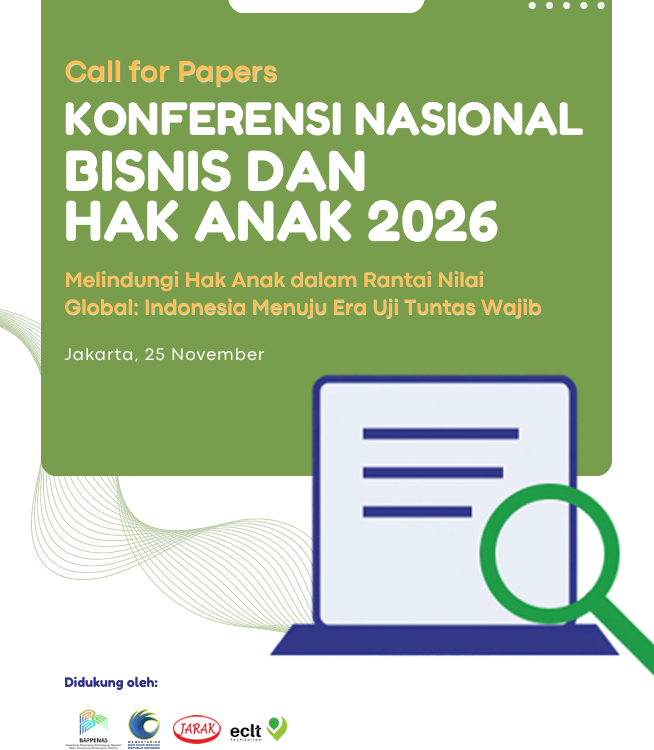
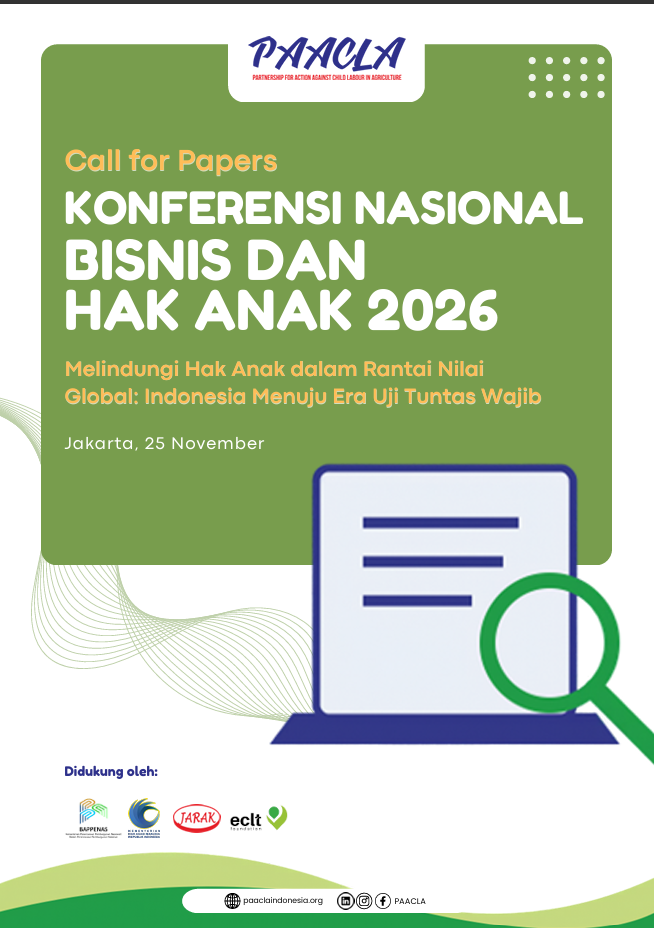
CALL FOR PAPERS: KONFERENSI NASIONAL BISNIS DAN HAK ANAK 2026
5 October 2026CALL FOR PAPERS: NATIONAL CONFERENCE ON BUSINESS AND CHILDREN’S RIGHTS 2026
Protecting Children’s Rights in Global Value Chains: Indonesia’s Transition to the Era of Mandatory Due Diligence
A. BACKGROUND
1. Child Labour: A Structural Issue at the Upstream End of Supply Chains
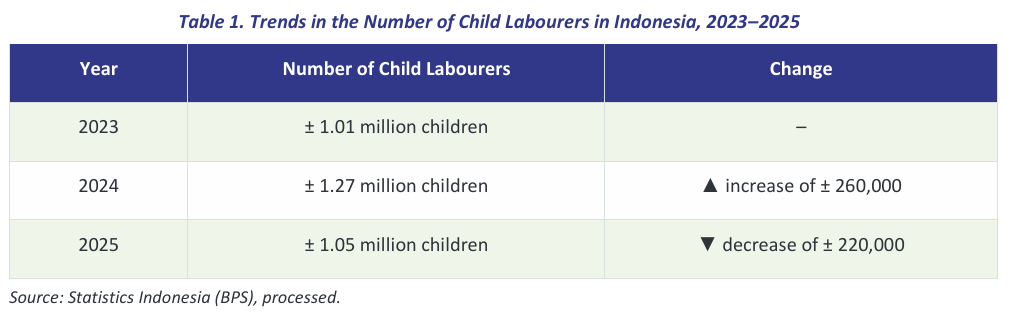
The agricultural and export commodity sectors are the backbone of Indonesia’s economy and a source of livelihood for millions of families. However, behind this contribution, children’s involvement in work, particularly at the upstream end of agricultural supply chains, remains an unresolved structural issue. Data from Statistics Indonesia (BPS) show that the number of child labourers increased from approximately 1.01 million children in 2023 to 1.27 million in 2024, before declining to around 1.05 million in 2025. The highest proportion is found in rural areas, particularly in agriculture, forestry, and fisheries.
This pattern is consistent with the global ILO and UNICEF (2025) estimates: of approximately 138 million child labourers worldwide in 2024, around 54 million were engaged in hazardous work, and 61% worked in agriculture, mostly in family businesses and small-scale farming. The same report confirms that Sustainable Development Goal (SDG) target 8.7, to end child labour in all its forms by 2025, was not achieved. The world, including Indonesia, needs a much greater acceleration of action, and business supply chains are one of the most strategic leverage points.
Table 1. Trends in the Number of Child Labourers in Indonesia, 2023–2025
These figures are highly dynamic because they follow planting and harvesting cycles. During harvest periods, the number of children working may increase sharply, and children may also move between different sectors of work. Because most child labour occurs in the informal sector and is hidden within family work, “blind spots” arise in monitoring and data collection, including within corporate due diligence systems that generally reach only direct (tier 1) suppliers.
The root causes are interconnected: smallholder farmers’ incomes remain below decent income levels; commodity prices fluctuate; piece-rate payment systems or work targets may encourage the involvement of family members; access to and the quality of education and childcare services in plantation and rural areas are limited; social protection is weak; and labour inspection in the informal sector is limited. Therefore, child labour in supply chains cannot be addressed by one party alone, but requires shared responsibility among government, buyers, suppliers, financial institutions, and communities.
2. From Voluntary Practices to Legal Obligations
The global market landscape is rapidly shifting from voluntary practices towards legal obligations, namely the era of mandatory due diligence. The European Union has implemented the Corporate Sustainability Reporting Directive (CSRD) since 2023 and adopted the Corporate Sustainability Due Diligence Directive (CSDDD) in 2024. These regulations require companies to identify, prevent, mitigate, and report human rights impacts, including child labour practices, throughout their value chains in a transparent and auditable manner. Although their scope and implementation timelines have been adjusted through the EU simplification package (Omnibus) in 2025-2026, the policy direction remains unchanged: major buyers and investors are still expected to demonstrate verifiable due diligence, and these requirements are passed on to suppliers in producer countries, including Indonesia.
The same direction can be seen in the EU Forced Labour Regulation, which will prohibit the circulation of products made with forced labour, including forced child labour, in the EU market from December 2027, as well as the EU Deforestation Regulation (EUDR), which requires commodities such as palm oil, cocoa, coffee, and rubber to comply with the laws and regulations of producing countries, including labour rights and human rights. In the United States, the Department of Labor’s Bureau of International Labor Affairs (ILAB) periodically publishes a list of goods produced with child labour and forced labour, which includes a number of Indonesian commodities, while Section 307 of the Tariff Act prohibits the importation of goods produced with forced labour, including child labour under forced labour or debt bondage.
Reporting standards such as the European Sustainability Reporting Standards (ESRS S2 on workers in the value chain), the Global Reporting Initiative (GRI 408: Child Labor), and the IFRS Sustainability Disclosure Standards affirm that the social dimension of ESG cannot be separated from the protection of children as one of the most vulnerable groups in supply chains. Accordingly, child-labour-free supply chains are no longer merely a corporate social responsibility issue, but a condition for market access, financing, and competitiveness. A single finding of child labour upstream can lead to goods being detained, contract termination, a decline in ESG ratings, and reputational losses across the entire chain.
Table 2. Key Global Instruments Relevant to the Elimination of Child Labour in Supply Chains
| Instrument | Nature and Status | Relevance to Zero Child Labour |
| ILO Conventions No. 138 and No. 182 | Binding; ratified by Indonesia through Law No. 20 of 1999 and Law No. 1 of 2000 | Minimum working age and prohibition of the worst forms of child labour (WFCL) |
| UN Guiding Principles on Business and Human Rights (2011) and Children’s Rights and Business Principles (2012) | International standards; key reference for human rights due diligence | Corporate responsibility to respect children’s rights and eliminate child labour throughout the value chain |
| OECD Guidelines for Multinational Enterprises (updated 2023) and OECD-FAO Guidance (2016) | Standards to be aligned with in the OECD accession process | Risk-based due diligence extending upstream, including child labour; grievance mechanism through the National Contact Point |
| EU CSRD/ESRS and CSDDD | Mandatory for companies within scope; adjusted through the Omnibus package | Obligations to identify, prevent, remedy, and report child labour in value chains |
| EU Forced Labour Regulation and EUDR | Mandatory; phased implementation | Prohibition of products made with forced labour (effective December 2027) and commodity legality requirements, including workers’ rights |
| ILAB List and Section 307 of the Tariff Act (US) | US trade instruments | Reputational risks and import restrictions concerning commodities linked to child labour and forced labour |
3. National Policy Framework
Indonesia has a strong legal foundation. In addition to ratifying ILO Conventions No. 138 and No. 182, the Labour Law prohibits employers from employing children, with a limited exception for light work by children aged 13-15 that does not interfere with their development, health, or schooling, and fully prohibits the worst forms of child labour for every child under 18. The Child Protection Law guarantees every child’s right to protection from economic exploitation. Indonesia has also established a National Action Plan for the Elimination of the Worst Forms of Child Labour and the 2022 Roadmap Towards a Child Labour-Free Indonesia. However, recent data indicate that these targets have not yet been achieved, requiring a new commitment and roadmap that directly involve the business sector.
At the same time, Indonesia is undergoing the process of accession to the Organisation for Economic Co-operation and Development (OECD), which requires alignment of national policies and practices with various OECD instruments, including the OECD Guidelines for Multinational Enterprises on Responsible Business Conduct, the OECD Due Diligence Guidance for Responsible Business Conduct, and the OECD-FAO Guidance for Responsible Agricultural Supply Chains. These instruments explicitly cover the elimination of child labour as well as the provision of effective grievance and remedy mechanisms. At the national level, Indonesia has established the National Strategy on Business and Human Rights (Stranas BHAM) through Presidential Regulation No. 60 of 2023, and the Government is preparing a regulatory framework on corporate obligations to conduct Human Rights Due Diligence (HRDD), aligned with the UN Guiding Principles on Business and Human Rights (UNGPs) and the Children’s Rights and Business Principles (CRBP).
4. The Zero Child Labour Agenda: From Commitment to System
The readiness of domestic businesses is uneven. Many companies have not yet specifically incorporated child labour risks into their due diligence systems; smallholder farmers, cooperatives, and micro, small, and medium enterprises (MSMEs) at the upstream end of supply chains risk being excluded from markets if they are not supported; while data, indicators, and child-friendly remediation mechanisms remain limited. For businesses, this situation presents both a challenge and an opportunity: companies that build child-labour-free supply chains earlier will be better positioned in global markets.
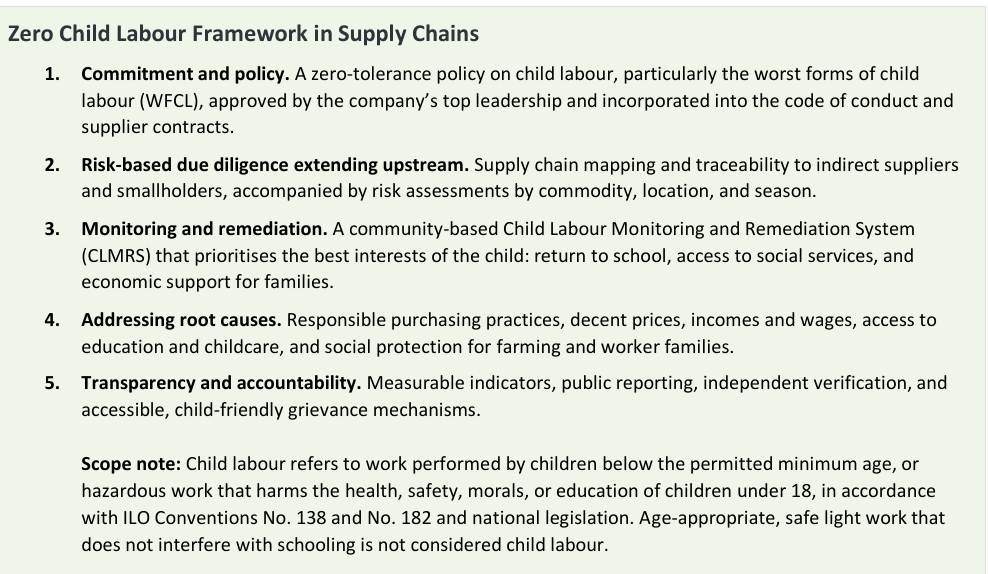
Therefore, this conference places the Zero Child Labour agenda in business supply chains at the centre of its discussion, meaning that there should be no child labour throughout a company’s supply chain, from its own operations to smallholder farms and indirect suppliers. Zero Child Labour does not mean a paper-based prohibition or cutting ties with suppliers found to employ children (“cut and run”). Such an approach may instead make child labour practices more hidden and worsen conditions for children and their families. Zero Child Labour is an outcome target achieved through a system of prevention, detection, remediation, and sustainable action to address root causes.
5. The National Conference as a Space for Collective Action
In this context, PAACLA Indonesia, as a multi-stakeholder alliance bringing together government, businesses, trade unions, civil society, academia, and children, is organising the National Conference on Business and Children’s Rights 2026. The conference is designed as a cross-sectoral space for knowledge production, exchange of good practices, and the formulation of evidence-based policy recommendations to achieve Zero Child Labour in Indonesia’s business supply chains in the era of mandatory due diligence. The conference is being opened through a Call for Papers, enabling academics, practitioners, companies, and civil society organisations from Indonesia and abroad to contribute directly as speakers in plenary and parallel sessions.
B. OBJECTIVES
Overall Objective
To promote cross-sectoral commitment and collective action to achieve Zero Child Labour in Indonesia’s business supply chains, in line with global human rights due diligence standards, as part of protecting children’s rights while strengthening Indonesia’s competitiveness in global markets.
Specific Objectives
- To consolidate cross-sectoral commitment to mainstream children’s rights and the elimination of child labour in sustainable business, human rights due diligence, and ESG reporting agendas, including promoting measurable and time-bound business commitments to Zero Child Labour.
- To map the implications of global regulations and standards (CSDDD, CSRD, EU Forced Labour Regulation, EUDR, and OECD instruments) for business governance and supply chains in Indonesia, particularly in the agricultural and commodity sectors, as well as the readiness of businesses to respond to them.
- To gather and exchange knowledge, research findings, and good practices among stakeholders, particularly models for child labour monitoring and remediation and approaches to addressing root causes at the upstream end of supply chains, through the Call for Papers and parallel discussion sessions.
- To promote stronger implementation of Child Rights Due Diligence (CRDD), sustainability reporting that includes child labour indicators, and child-friendly grievance and remedy mechanisms.
- To formulate evidence-based policy recommendations for government, businesses, and civil society, including inputs for the development of national HRDD regulations, a new national roadmap for the elimination of child labour, and Indonesia’s OECD accession process.
C. EXPECTED OUTCOMES
- Stronger cross-sectoral commitment to integrating children’s rights into corporate human rights due diligence, ESG reporting, and the alignment of national policies with global standards.
- Opportunities, challenges, and gaps in Indonesia’s readiness to meet global business and human rights standards related to the protection of children’s rights in value chains are mapped.
- Selected papers are compiled and presented in plenary and parallel sessions and published in the Proceedings of the National Conference on Business and Children’s Rights 2026 (ISBN).
- A policy recommendation document and Joint Declaration of the conference are prepared and submitted to government, businesses, and relevant stakeholders.
- Networks and collaboration among government, businesses, academia, civil society, and international partners are strengthened, including through the establishment of a cross-sectoral working group to monitor follow-up to the conference commitments and recommendations.
D. THEME, KEY QUESTIONS, AND SUB-THEMES
Main Theme:
“Protecting Children’s Rights in Global Value Chains: Indonesia’s Transition to the Era of Mandatory Due Diligence”
The conference discussions are intended to address the following key questions:
- To what extent do global due diligence regulations and standards influence business practices and Indonesian commodity supply chains, and what impact do they have on efforts to eliminate child labour?
- What does realistic and verifiable Zero Child Labour mean in Indonesian commodity supply chains, what are its prerequisites, and how can it be achieved without excluding smallholder farmers and small suppliers from the market?
- How can child rights due diligence and child labour monitoring and remediation systems be effectively implemented throughout the upstream end of supply chains, including indirect suppliers?
- What policies, regulations, institutional support, and financing are needed to prepare Indonesia for the era of mandatory due diligence and the OECD accession process?
- How can children’s voices and remedy mechanisms become part of corporate due diligence systems?
The main theme is elaborated into four sub-themes, all grounded in the agenda to eliminate child labour (Zero Child Labour) in business supply chains and value chains. These four sub-themes will also serve as the parallel sessions and Call for Papers tracks:
Table 3. Conference Sub -Themes
| N0 | Sub -Theme | Scope and Example Topics |
| I | Child Rights Due Diligence and the Elimination of Child Labour in Commodity Supply Chains and Value Chains | Integrating the child labour elimination agenda (Zero Child Labour) into corporate human rights due diligence practices, from company policies to the upstream supply chain and the entire value chain. Child labour impact assessment and risk mapping by commodity, location, and season (child rights impact assessment)Zero Child Labour policies, children’s rights clauses in supplier contracts, and responsible purchasing practicesSupply chain traceability to indirect suppliers, smallholders, cooperatives, and piece-rate workersChild Labour Monitoring and Remediation Systems (CLMRS) in plantations, processing, and industryShared responsibility among buyers, intermediaries, and suppliers: sharing the costs of due diligence and remediation throughout the value chainCross-commodity case studies: palm oil, tobacco, cocoa, coffee, rubber, fisheries, and others |
| II | Child-Labour-Free Supply Chains in Sustainability Reporting, ESG, and Financing | How sustainability reporting, certification, and financing can promote measurable and verifiable child-labour-free supply chains and value chains. Double materiality and child labour indicators in CSRD/ESRS, GRI 408, IFRS, and SASBEffectiveness of commodity certification standards (RSPO, ISPO, Rainforest Alliance, Fairtrade, and others) in detecting and addressing child labourSupply chain traceability, third-party verification, and the role of auditors and ESG rating agenciesThe role of financial institutions and investors in requiring and financing child-labour-free supply chains |
| III | Harmonisation of National Policies with Global Standards for the Elimination of Child Labour: HRDD Regulation, Stranas BHAM (National Strategy on Business and Human Rights), and OECD Accession | Indonesia’s policy and institutional readiness to eliminate child labour in supply chains and prepare for the era of mandatory due diligence. Implications of CSDDD, CSRD, EU Forced Labour Regulation, and EUDR for Indonesian exporters and suppliersDraft national HRDD regulations, implementation of Stranas BHAM, and a national roadmap for the elimination of child labour |
| Implementation of the OECD Guidelines, OECD Due Diligence Guidance, and OECD-FAO Guidance; readiness of the National Contact Point (NCP)Strengthening labour inspection, including in the informal sector and smallholder plantationsSupport for MSMEs and smallholders to remain connected to global markets without child labour | ||
| IV | Child Participation, Remediation, and Addressing Root Causes of Child Labour in Value Chains | How children’s voices, particularly those of children directly affected by business practices, can be part of the design of policies, sustainability programmes, grievance mechanisms, and child labour remediation and prevention efforts. Meaningful child participationAccess to remedy and child-friendly grievance mechanismsCommunity-based monitoring, child-friendly villages, and child safeguardingDecent incomes and wages, education and childcare services, and social protection; digital innovations for case reporting |
E. CALL FOR PAPERS
The conference invites academics, researchers, private-sector practitioners, sustainability consultants, civil society organisations, postgraduate students, and policymakers to submit papers addressing one of the conference sub-themes. Papers presenting evidence, models, or lessons learned on efforts to achieve Zero Child Labour in supply chains are particularly encouraged.
The Call for Papers is open to contributors from Indonesia as well as international institutions, including universities, research institutions, multinational companies, international non-governmental organisations, sustainability standards organisations, and bilateral and multilateral development partners with programmes, investments, business relationships, or research interests in Indonesia. International contributions are expected to enrich comparative perspectives and cross-jurisdictional experience, particularly regarding the implementation of due diligence regulations and global supply chains.
1. Types of Contributions
- Academic research papers (empirical or conceptual).
- Case studies of policy or programme implementation in the private sector, government, or communities.
- Policy briefs or policy analyses.
- Good practices that can be replicated.
2. Manuscript Requirements
- Written in Indonesian or English.
- Abstract of no more than 300 words, accompanied by 3-5 keywords.
- Full manuscript of 4,000-8,000 words (excluding references).
- APA (American Psychological Association) 7th edition citation style.
- The manuscript must be the author’s original work and must not have been previously published in another journal or proceedings. Manuscripts developed from previous publications must acknowledge the original source.
Please submit the Registration and Abstract Submission Form via the following link:
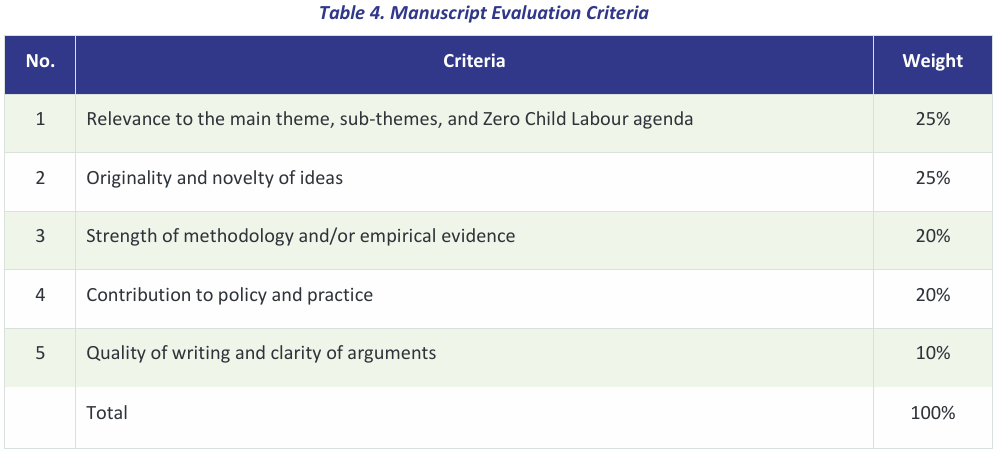
3. Evaluation Criteria
4. Timeline (Tentative)
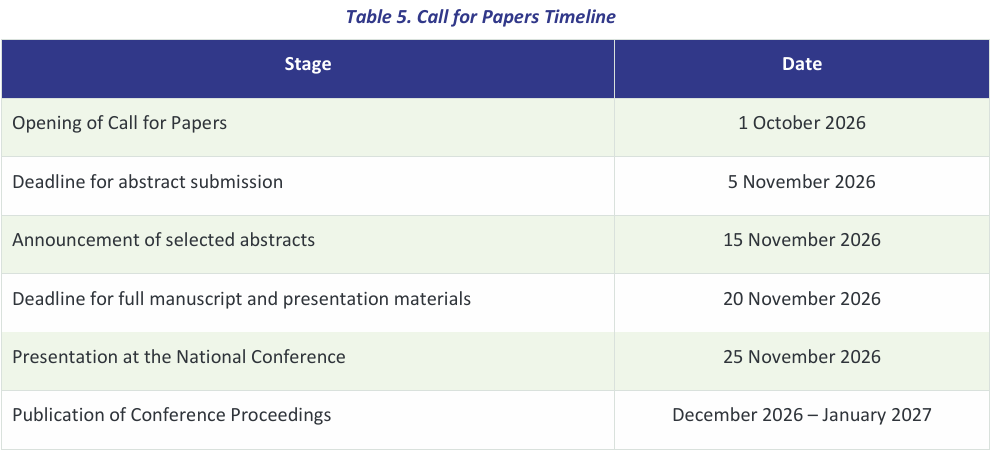
5. Benefits for Selected Presenters
- Opportunity to present the paper in a parallel or plenary session of the conference.
- Publication of the paper in the Proceedings of the National Conference on Business and Children’s Rights 2026 (ISBN).
- Publication of the best paper from each sub-theme through PAACLA Indonesia’s official publication channels.
- Accommodation and travel costs for selected presenters from Indonesia who reside outside the event location, subject to the organisers’ provisions.
- International presenters may attend at their own expense or present online through arrangements facilitated by the organisers.
- Honorarium in accordance with PAACLA Indonesia’s financial standards and a presenter certificate.
6. Submission and Selection Process
Abstracts and full manuscripts should be submitted through the official PAACLA Indonesia email address, which will be announced when the Call for Papers opens. Each manuscript will undergo a double-blind peer review by the Conference Scientific Committee, comprising representatives of:
- Ministry of Human Rights;
- Putu Elvina, S.Psi., M.M. (Commissioner, National Human Rights Commission);
- Abdul Hakim (Project Officer, ILO Indonesia – Timor-Leste);
- Setiawan Cahyo Nugroho (Child Protection Specialist – UNICEF Indonesia);
- Dr. Fitriana, S.H., M.H. (Lecturer, Faculty of Law, Universitas Indonesia);
- Muhammad Hafiz (Executive Director, Centra Initiative Indonesia);
- PAACLA Indonesia National Secretariat
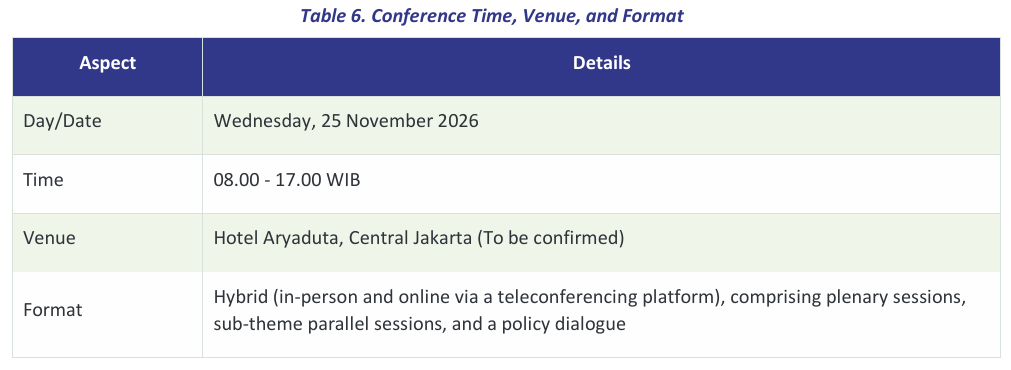
F. TIME, VENUE, AND FORMAT
G. TENTATIVE AGENDA
Table 7. Tentative Conference Agenda
| Time (WIB) | Session | Activity |
| 08.00–09.00 | Registration | Registration of in-person and online participants. |
| 09.00–09.45 | Opening | Singing of the Indonesian national anthem, Indonesia Raya; organisers’ report; remarks by the PAACLA Indonesia Coordinator; welcome remarks and official opening by a government official. |
| 09.45–12.00 | Plenary Session I: Keynote and Featured Papers | Keynote addresses from the Ministry of Human Rights, Coordinating Ministry for Economic Affairs, and development partners (ECLT Foundation, ILO, UNICEF, and others) on the urgency of Zero Child Labour in supply chains; presentation of |
| featured papers selected through the Call for Papers. | ||
| 12.00–13.00 | Break | Lunch and prayer break. |
| 13.00–15.00 | Parallel Sessions | Four parallel sessions according to the sub-themes: Child Rights Due Diligence and the Elimination of Child Labour in Commodity Supply Chains and Value ChainsChild-Labour-Free Supply Chains in Sustainability Reporting, ESG, and FinancingHarmonisation of National Policies with Global Standards for the Elimination of Child LabourChild Participation, Remedy, and Addressing Root Causes of Child Labour in Value Chains Presentation of selected papers, panel discussions, and formulation of recommendations for each session. |
| 15.00–15.15 | Break | Coffee break. |
| 15.15–16.30 | Plenary Session II: Policy Dialogue | Presentation of the findings and recommendations from the four parallel sessions; panel dialogue among government, businesses, and civil society on the Zero Child Labour Roadmap for supply chains, readiness for the era of mandatory due diligence, and OECD accession. |
| 16.30–17.00 | Closing | Conclusions and recommendations; signing of the Joint Declaration and Zero Child Labour Business Commitment; award for the best paper; official closing of the conference. |
H. PARTICIPANTS
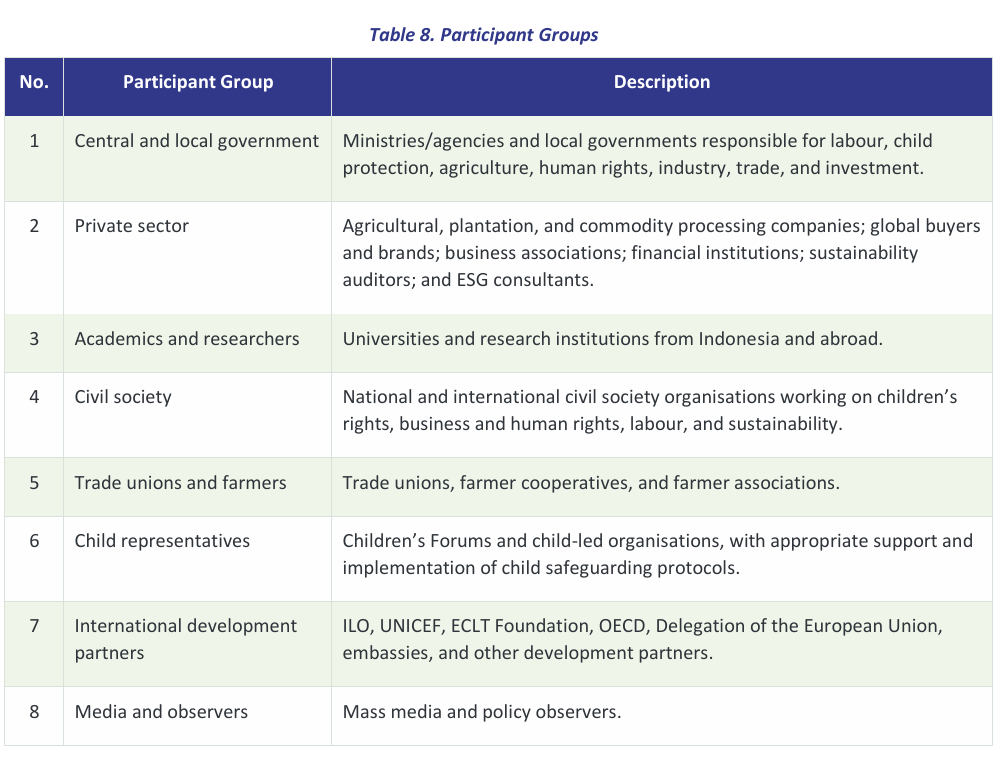
The conference is open to cross-sectoral stakeholders, with approximately 150 invited in-person participants, in addition to online participants. The participation of company leaders and business associations in the commodity sector is prioritised, given their strategic role in advancing the Zero Child Labour commitment.
I. ORGANISERS
The National Conference on Business and Children’s Rights 2026 is organised by PAACLA Indonesia under the coordination of the Ministry of National Development Planning/Bappenas, in cooperation with the Ministry of Human Rights and all PAACLA Indonesia members representing government, business, trade unions, academia, and civil society organisations, with support from the ECLT Foundation.
J. CLOSING
The National Conference on Business and Children’s Rights 2026 is expected to mark a new milestone in the collaborative movement towards Zero Child Labour in Indonesia’s business supply chains. Through a cross-sectoral and interdisciplinary space for knowledge production, the conference is expected not only to generate commitments, but also evidence, ideas, recommendations, and measurable follow-up actions for government, businesses, and civil society.
Child-labour-free supply chains are not only a compliance requirement for access to global markets, but also a concrete expression of respect for every child’s right to grow, learn, and play. With this spirit, Indonesia is expected to be able to face the era of mandatory due diligence with confidence, while moving towards OECD membership as a responsible and sustainable country.
— PAACLA Indonesia —